
Ultra-compact wearable devices used close to the body, such as hearing aids, smart rings, and blood glucose sensors, need to accommodate numerous electronic components within extremely limited space. This has created demand for further miniaturization and lower profiles in 32.768 kHz crystal resonators used as reference clocks.
However, miniaturizing a crystal resonator is not simply a matter of reducing its external dimensions. In the ultra-compact range of 1210 size and smaller, the space inside the package becomes increasingly limited, making it difficult to ignore the effects of even trace amounts of outgassing and other factors that are less likely to pose problems in larger packages.
River Eletec addresses these challenges with MDS (solid-phase diffusion bonding) technology, which eliminates the need for conductive adhesives. This article explains how MDS works, its proven track record in mass production with the TFX-05X, and its application to AT-cut crystal resonators.
Miniaturization of Crystal Resonators for IoT and Wearable Devices
Ultra-compact wearable devices such as hearing aids, smart rings, and blood glucose sensors need to accommodate numerous components, including communication modules, sensors, power supply components, and batteries, within a limited PCB area. As devices become smaller and thinner, individual electronic components are also required to take up less space and have lower profiles.
The 32.768 kHz tuning-fork crystal resonator is another essential component, serving as a reference clock for RTCs and low-power operation. As applications expand from conventional watches and wristband-type devices to devices designed to be worn in closer integration with the body, crystal resonators must be designed not only for smaller size, but also with lower profiles and reliability in mind.
Growing Demand for Smaller Electronic Components in High-Density Mounting Applications
Ultra-compact wearable devices such as hearing aids, smart rings, and blood glucose sensors need to incorporate numerous functions within limited PCB space. As communication modules, sensors, power supply components, and other components are mounted at increasingly higher densities, crystal resonators must offer both a smaller footprint and a lower profile.
In fact, demand for crystal resonators has expanded from the conventional 1610 size to 1210 and smaller sizes. As surrounding components such as capacitors shrink to 0603 and even 0402 sizes, the height of the crystal resonator can become a determining factor in the overall thickness of the PCB assembly.
Further reductions in device size and thickness therefore require crystal resonators with a smaller footprint and lower profile.
Package Structures Need to Be Reconsidered for 1210 and Smaller Sizes
Miniaturizing crystal resonators to 1210 and smaller sizes is difficult to achieve simply by scaling down conventional structures. As external dimensions decrease, there is less internal space and less flexibility in component placement, making it increasingly difficult to ignore the effects of trace amounts of gases and other factors that pose little concern in larger packages.
For ultra-miniaturization, simply reducing component dimensions is not enough. The entire package must be designed with careful consideration of factors including the internal materials and bonding methods.
In the 1210-and-smaller range, it is important to shift the focus from “how far can conventional structures be scaled down?” to “how can we create a structure optimized for ultra-miniaturization?”
The Impact of Trace Outgassing in Ultra-Miniaturized Crystal Resonators
Conventional-size crystal resonators have a certain amount of space inside the package, allowing the required performance and reliability to be maintained even in structures that use conductive adhesives. However, as crystal resonators are miniaturized to 1210 and smaller sizes, the internal volume decreases, making it increasingly difficult to ignore the effects of trace outgassing that are less likely to pose problems in larger packages.
With ultra-miniaturization, it is important to consider not only the external dimensions, but also the internal materials and overall package structure as part of the design process.
The Effects of Internal Gases Become More Pronounced with Ultra-Miniaturization
As the internal volume of a package decreases, the relative impact of the same amount of outgassing on the internal environment becomes greater. Outgassing refers to trace amounts of gases released from materials such as adhesives.
Even amounts that are unlikely to cause problems in conventional-size packages can alter the internal environment of ultra-compact packages, potentially affecting frequency characteristics due to factors such as trace substances adhering to the crystal surface. For 1210 and smaller sizes, designs must minimize the use of materials that can generate outgassing and maintain a stable internal environment.
Ultra-Miniaturization Creates New Design Challenges
There is nothing inherently problematic about conventional structures that use conductive adhesives. In products measuring 1610 or larger, where there is sufficient internal space, conventional structures can provide the required performance and reliability.
These challenges become more apparent when moving into the ultra-compact range of 1210 and smaller sizes. As the available internal space becomes extremely limited, greater consideration must be given to factors such as outgassing and material placement that are less likely to pose significant issues in conventional-size products.
MDS is not a technology designed to compensate for shortcomings in conventional products. Rather, it is a structure developed to meet the new challenges associated with ultra-miniaturization
MDS (Solid-Phase Diffusion Bonding): Breaking Through the Barriers to Ultra-Miniaturization
Ultra-compact crystal resonators require a fundamental reconsideration of not only their external dimensions but also their internal structure. River Eletec’s MDS (solid-phase diffusion bonding) technology integrates three crystal wafers—the cap, resonator, and base—into a single unit, using the crystal itself as the package.
Because MDS does not use conductive adhesives, it eliminates a source of adhesive-derived outgassing, which can become an issue with ultra-miniaturization, while enabling a structure optimized for the limited internal space available.
A Three-Layer “Crystal × Crystal × Crystal” Case
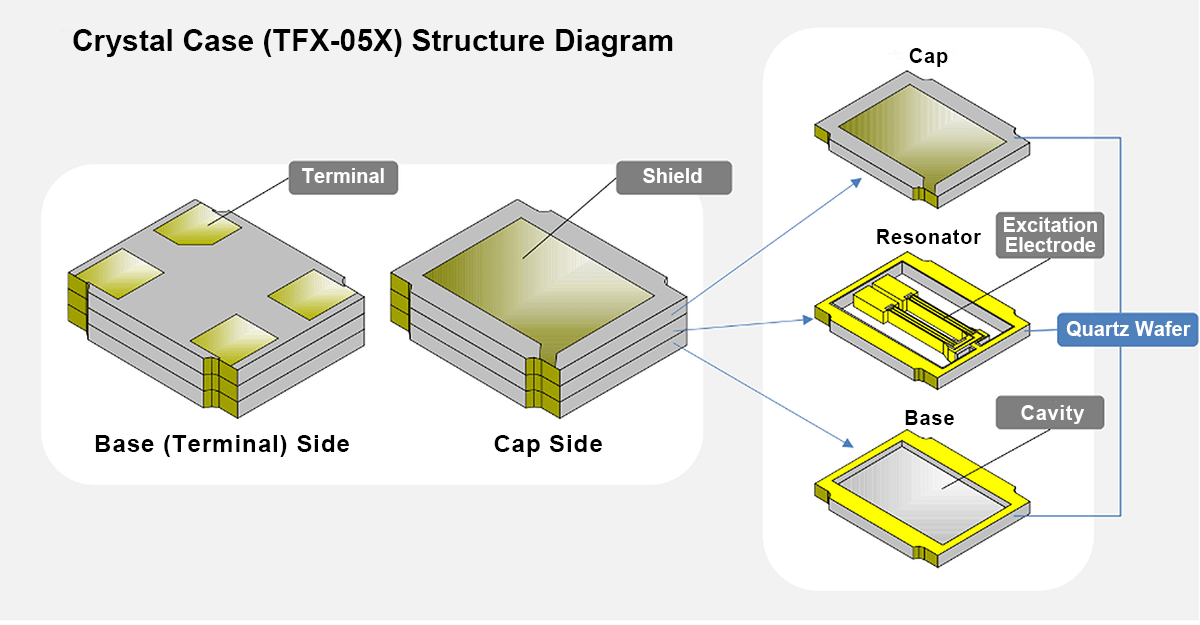
One of the key features of MDS is its “crystal case,” in which crystal is used for all three layers: the cap, resonator, and base. In conventional structures, the case and crystal element are separate components, whereas MDS uses the crystal itself as part of the package.
The required structures are formed on each of the three crystal wafers, which are then stacked with the resonator sandwiched between the cap and base. This integrates the space needed to protect the resonator with the package itself. In essence, the case is constructed entirely from “crystal × crystal × crystal.”
Even in ultra-compact applications where the number of components and available internal space are severely constrained, this approach facilitates miniaturization through the package structure itself.
How Solid-Phase Diffusion Bonding Integrates the Three Layers
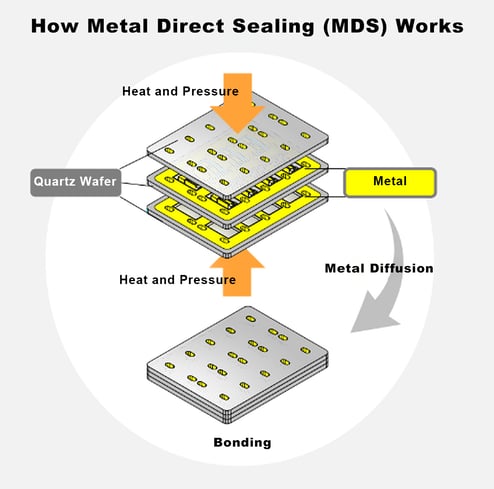
Solid-phase diffusion bonding, the core technology behind MDS, is used to integrate the three crystal wafers into a single unit. A metal layer is formed on the bonding surface of each wafer. The polished surfaces are then brought together and bonded by applying heat and pressure in a vacuum.
Solid-phase diffusion bonding is a process in which metals are joined without melting, with heat causing atoms to diffuse across the bonding interface and form an integrated structure. MDS requires no applied voltage during bonding and does not use conductive adhesives.
By firmly bonding the cap, resonator, and base into a single unit, MDS makes it easier to maintain a simple structure even in ultra-compact packages.
Adhesive-Free Structure Supports Ultra-Miniaturization and Stable Performance
Because MDS does not use conductive adhesives, it eliminates the source of adhesive-derived outgassing altogether. In ultra-compact packages with limited internal volume, even trace amounts of gas can potentially affect performance, making the adhesive-free structure a significant advantage in achieving further miniaturization.
Another key feature of solid-phase diffusion bonding is its ability to minimize stress at the bonding interface. By reducing unwanted stress on the crystal, this approach helps maintain excellent characteristics, including at high frequencies, as well as long-term stability.
Rather than simply scaling down a conventional structure, MDS is a technology that fundamentally redesigns the package structure for ultra-miniaturization.
TFX-05X: Demonstrating MDS as a Mass-Production Technology
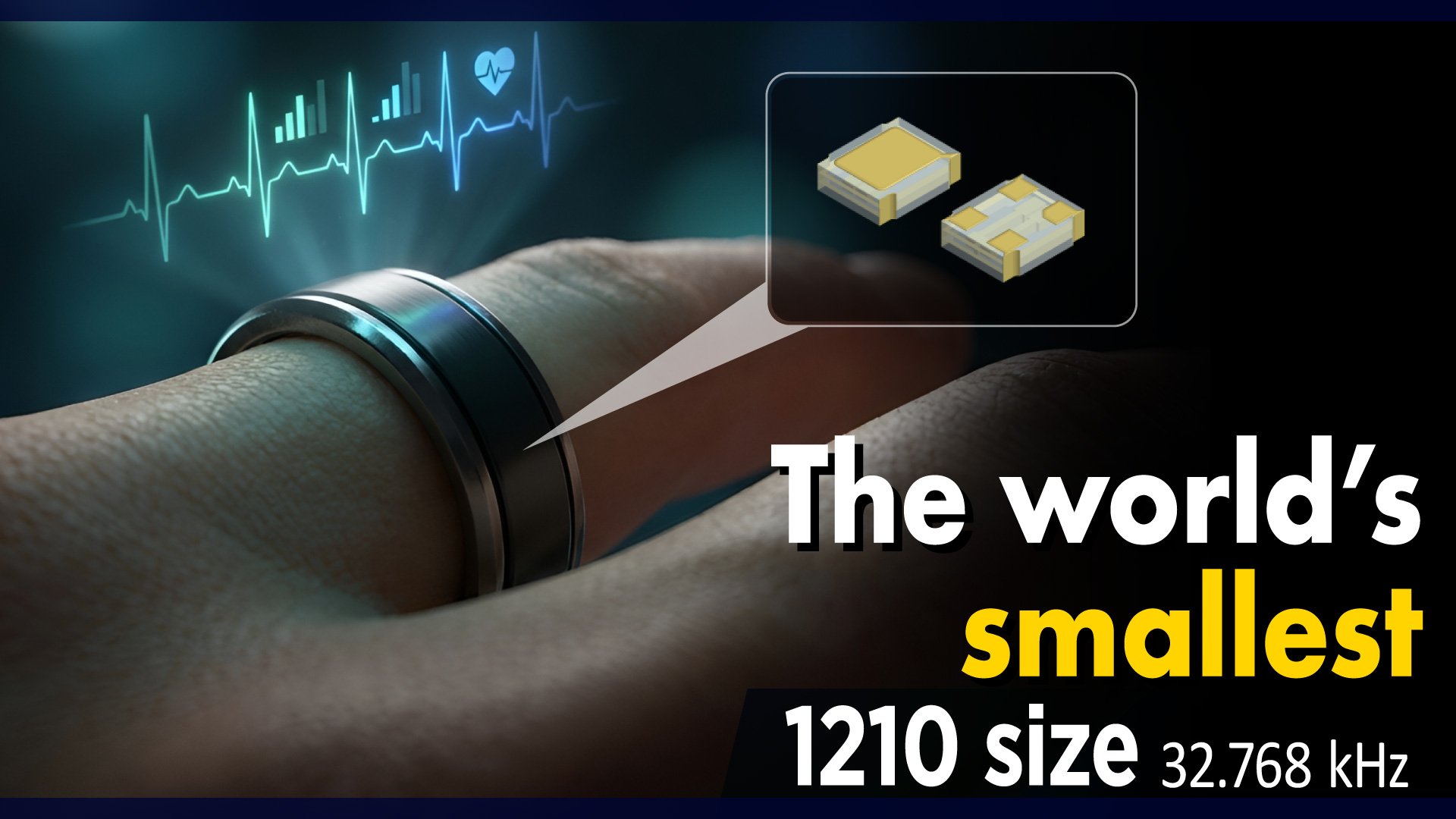
MDS is not a technology limited to the research or prototyping stage. River Eletec mass-produces the TFX-05X, a 32.768 kHz tuning-fork crystal resonator featuring a crystal case based on MDS technology.
With maximum dimensions of just 1.2 × 1.0 × 0.35 mm, the TFX-05X is used in ultra-compact wearable devices with stringent mounting-space and height constraints, including hearing aids, smart rings, and blood glucose sensors. In addition to its compact size and low profile, the TFX-05X demonstrates the practical viability of MDS through its mounting strength, long-term stability, and proven track record in the market.

1210 Size and 0.35 mm Max. Height Contribute to Thinner Device Designs
The TFX-05X measures just 1.2 × 1.0 × 0.35 mm Max., making it an ultra-compact, 1210-size tuning-fork crystal resonator. Compared with the conventional 1610-size TFX-04, it achieves a 47.5% reduction in volume and a 75% reduction in weight, saving space not only in terms of PCB footprint but also in the vertical dimension.
|
Comparison Item |
TFX-04 |
TFX-05X |
|
Size |
1610 |
1210 |
|
Dimensions |
1.6×1.0×0.5mm Max. |
1.2×1.0×0.35mm Max. |
|
Frequency |
32.768kHz |
32.768kHz |
|
Series Resistance |
90kΩ Max. |
90kΩ Max. |
|
Volume |
Reference |
47.5% reduction |
|
Weight |
2.7mg |
0.8mg |
|
Package Structure |
Ceramic + metal lid, electron-beam sealing |
Crystal case, MDS |
|
Key Features |
Standard 1610-size model |
Maintains 90 kΩ Max. series resistance despite its smaller size and lower profile |
As surrounding components such as capacitors shrink to 0603 and even 0402 sizes, the height of the crystal resonator can become a determining factor in the overall thickness of the PCB assembly. With a maximum height of just 0.35 mm, the low-profile design provides a significant advantage by increasing design flexibility in applications where thinness is critical, such as hearing aids, smart rings, and blood glucose sensors.
Proven Mass-Production Track Record of Over 30 Million Units
Cumulative shipments of the TFX-05X have already exceeded 30 million units, demonstrating that MDS has been successfully commercialized. Despite its innovative package structure, the TFX-05X has a proven track record of consistent production and adoption across a wide range of devices.
Applications include ultra-compact wearable devices such as hearing aids, smart rings, and blood glucose sensors, where low-profile designs, high-density mounting, and high reliability are essential. The milestone of more than 30 million units shipped demonstrates the maturity and proven reliability of MDS as a manufacturing technology.
Mounting Strength and Robustness Comparable to Ceramic Packages
Despite its ultra-compact, three-layer crystal structure, the TFX-05X provides the strength needed to withstand the thermal and mechanical stresses encountered during mounting. With MDS, metal films such as gold are joined through solid-phase diffusion bonding to achieve high bond strength.
The resulting bond strength is comparable to that of conventional ceramic packages, enabling the TFX-05X to withstand reflow processes and stresses during mounting. Although mounting strength can be a concern with ultra-compact, three-layer crystal structures, MDS combines ultra-miniaturization with excellent robustness.
Its proven track record of more than 30 million units shipped further demonstrates that MDS is a mature and commercially proven manufacturing technology.
Designed for Long-Term Stability as Well as Miniaturization
For ultra-compact wearable devices, reducing component size is not the only consideration. Maintaining stable frequency characteristics over extended periods is equally important. MDS uses no conductive adhesives and employs solid-phase diffusion bonding to minimize stress at the bonding interfaces.
For hearing aids, smart rings, and blood glucose sensors that are worn close to the body for extended periods, long-term stability is an important factor in the overall reliability of the device. Aging data therefore provides an important means of evaluating the long-term stability of products incorporating MDS.
The TFX-05X is designed not only for compact size and a low profile, but also with long-term stability in mind.
MDS Expands from Tuning-Fork to AT-Cut Crystal Resonators
MDS is not limited to the TFX-05X 32.768 kHz tuning-fork crystal resonator. River Eletec is also applying the bonding and sealing technologies developed through the TFX-05X to the ultra-miniaturization of AT-cut crystal resonators used at higher frequencies.
By applying this proven manufacturing technology to other types of crystal devices, River Eletec is addressing the growing demand for further miniaturization.
Extending Proven MDS Technology to AT-Cut Crystal Resonators
The MDS bonding and sealing technologies commercialized and proven through the TFX-05X are also being applied to the ultra-miniaturization of AT-cut crystal resonators. AT-cut crystal resonators are typically used at higher frequencies than tuning-fork types and play an important role as reference clocks in communication equipment and a wide range of electronic devices.
By extending the MDS technology developed for tuning-fork crystal resonators to AT-cut devices, River Eletec is advancing miniaturization across crystal devices used for different applications. Rather than being a structure limited to a specific product, MDS is expanding its role as a core technology supporting the next generation of ultra-compact crystal devices.
Development of the World’s Smallest 0806-Size AT-Cut Crystal Resonator
In December 2024, River Eletec developed the MDS-AT0806 (provisional name), an AT-cut crystal resonator measuring just 0.8 × 0.6 × 0.3 mm Max. and incorporating MDS technology. At the time of its announcement in December 2024, it was the world’s smallest AT-cut crystal resonator.
By extending MDS, already proven in the TFX-05X, from a 1210-size tuning-fork crystal resonator to an 0806-size AT-cut crystal resonator, River Eletec has demonstrated the technology’s potential for ultra-miniaturization across different types of crystal devices. Although the MDS-AT0806 is currently under development, it is expected to find applications in fields requiring even greater space savings, including IoT equipment and devices with high-density component mounting.
Summary | MDS Technology Enables Ultra-Compact Crystal Resonators
Ultra-compact wearable devices such as hearing aids, smart rings, and blood glucose sensors require crystal resonators that combine compact dimensions and a low profile with high reliability. As crystal resonators shrink to 1210 and smaller sizes, the reduced internal space makes it increasingly important to consider factors such as outgassing that are less significant in conventional-size packages.
River Eletec’s MDS technology combines a three-layer crystal case, solid-phase diffusion bonding, and an adhesive-free structure to achieve ultra-miniaturization while maintaining mounting strength and long-term stability. The TFX-05X achieves a 1210-size footprint with a maximum height of 0.35 mm and has surpassed cumulative shipments of 30 million units.
MDS is also being applied to the development of the 0806-size MDS-AT0806 AT-cut crystal resonator. As a core technology for enabling the next generation of ultra-compact crystal devices, MDS is expected to find even broader applications in the future.