
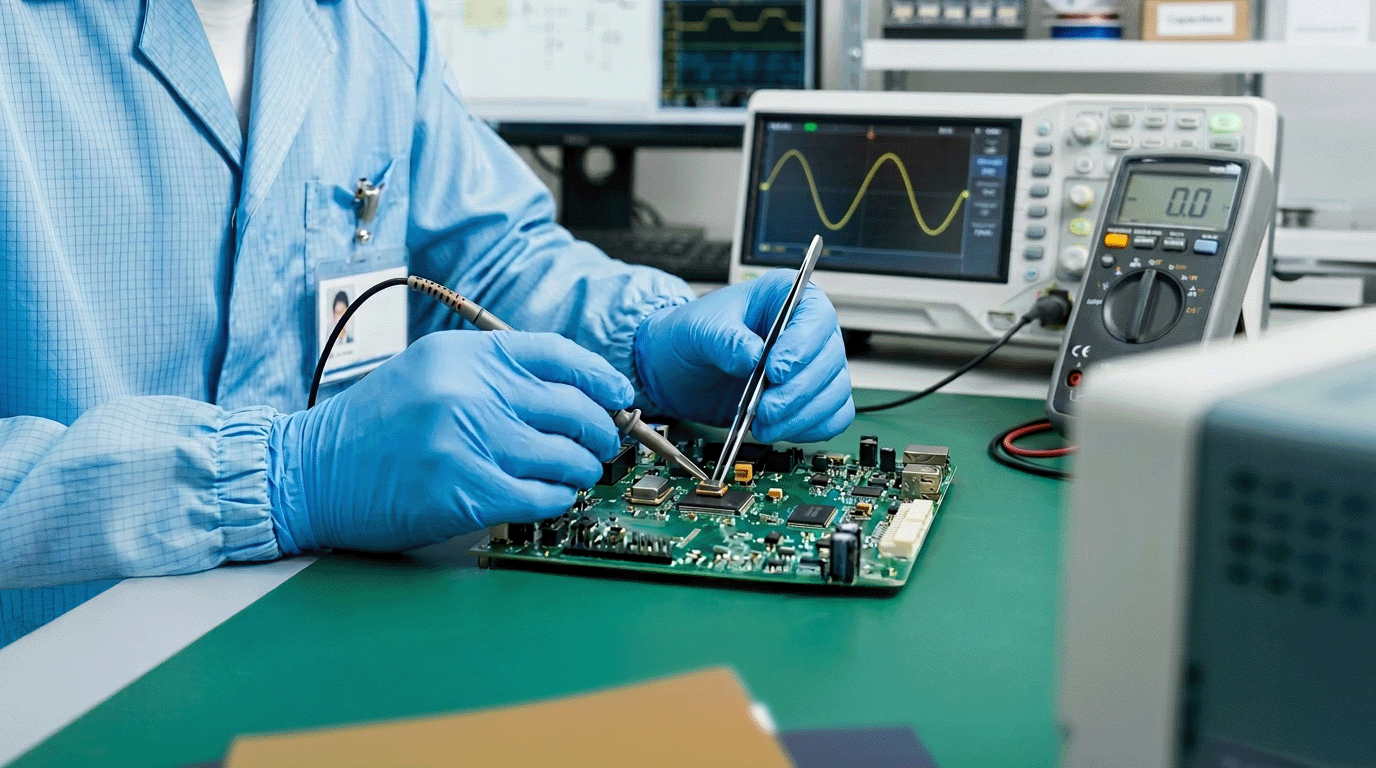
 "We changed the MCU, and the crystal resonator stopped oscillating."
"During low-temperature testing, the clock suddenly delayed (or stopped) completely."
In the hardware design of IoT and industrial equipment, "crystal oscillation failure" is a severe issue that engineers worldwide face at least once. When encountering unexplained troubles, the first critical metric to suspect and verify is "Negative Resistance" (oscillation margin).
What is "Negative Resistance" That Ensures Crystal Oscillation?
For a crystal resonator to continue oscillating stably, the oscillation circuit side (such as an MCU or IC) must have enough "energy" (amplification capability) to overcome the resistance components of the crystal and the circuit. The metric indicating this amplification capability on the circuit side is known as "Negative Resistance."
Generally, as an oscillation stability condition to guarantee stable performance, it is recommended that the negative resistance value is at least 3 times (or 5 times) the Equivalent Series Resistance (ESR) of the crystal resonator.
- Insufficient Negative Resistance: Oscillation startup becomes slow, or in the worst case, it does not start at all, or stops due to slight environmental changes like temperature variations.
- Excessive Negative Resistance: While oscillation starts more easily, an overly strong amplification circuit places an excessive load (Drive Level) on the crystal. This triggers the risk of abnormal oscillation (such as spurious or higher-order vibration modes) and can lead to characteristic degradation or physical damage to the resonator.
Why is Designing Simply According to the Datasheet (CL Value) Not Enough?
We often hear comments like, "We implemented the recommended capacitor values (Cg, Cd) listed in the IC datasheet, but the frequency shifts or it doesn't oscillate."
The primary reason is the presence of "stray capacitance" (parasitic capacitance) on the actual printed circuit board (PCB).
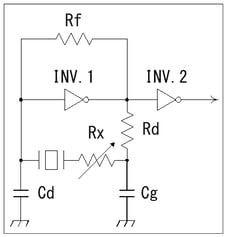 Unexpected minute capacitance is generated depending on the PCB wiring patterns and component layout. The recommended values on datasheets are based strictly on ideal environments and do not account for the stray capacitance unique to your specific board layout. Therefore, the optimal matching constants (Cg, Cd, Rd) will inevitably vary for each individual board.
* Negative resistance is calculated by inserting a variable resistor (Rx) in series with the crystal and finding the resistance value at which oscillation stops.
Eliminate Pre-Production Anxiety. River Eletec's "Free IC Matching Service"
To prevent such oscillation troubles and ensure product quality, an IC matching evaluation using the actual circuit board is essential. However, many design teams do not have precise evaluation equipment or specialized know-how in-house.
Therefore, River Eletec offers an IC Matching Service (Free of Charge), proposing optimal circuit constants so that customers can use our crystal devices safely and reliably.
[ 3 Features of River Eletec's Matching Service ]
- Proposal of Optimal Circuit Constants: If oscillation stability conditions are not met, our dedicated engineers will calculate the optimal circuit constants (Cg, Cd, Rd) tailored to your board and make specific modification proposals.
- "On-Site Support" for Highly Confidential Boards: For boards that cannot be taken off-site or cases with special software environments, our circuit evaluation engineers can visit your facility for an on-site evaluation, or you can visit us for an attended evaluation.
- Speedy Response (As fast as 1 day for expedited requests): We usually report the detailed investigation results within about 1 week after our sales representative receives your circuit board and documents. If your development schedule is exceptionally tight, we also accept Expedited Requests (as fast as 1 day after receiving the board).
Prevent Field Failures and Ensure Long-Term Product Reliability
Crystal resonators with the optimal specifications derived from the matching evaluation will be arranged quickly by our dedicated sample support team. We deliver with overwhelming speed: as fast as 3 days for in-stock items, and as fast as 3 weeks (1 month if new design is involved) even when a new build is required.
Eliminate the pre-production anxiety of non-oscillation. Please take advantage of reliable matching evaluations by professionals and our ultra-fast sample delivery.